
01
Multi-agent collaboration under a shared control plane
AI Agents
A governed multi-agent workforce for banking operations
Agent Bank is an enterprise multi-agent platform that executes high-volume banking workflows—with policy controls, audit trails, and human approval gates for anything that moves money or risk.
View Agent Bank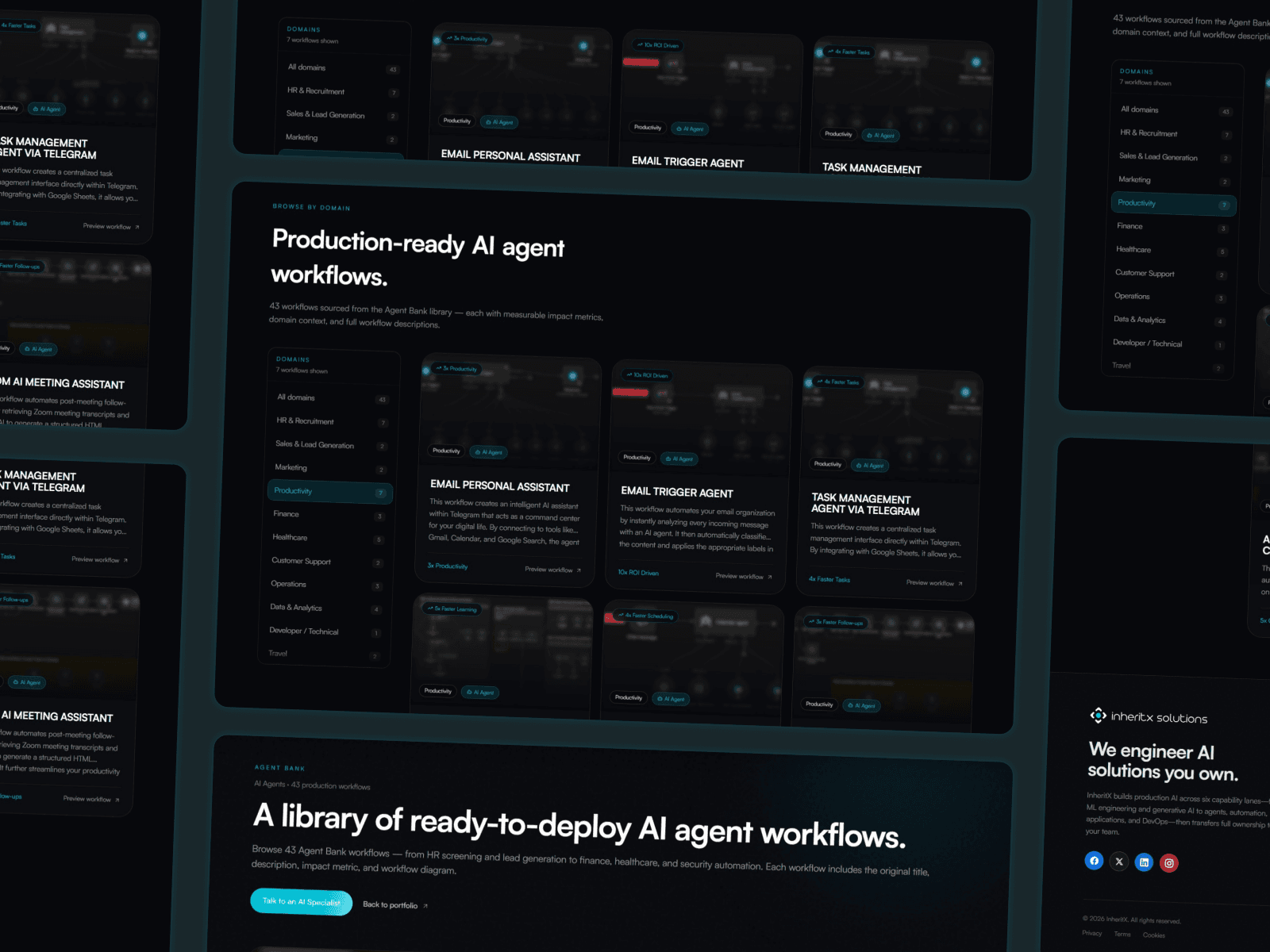
6×
Faster exception review cycles
Engagement-reported
24/7
Logged coverage on routine ops
Design control
Ledger
Tool actions attributable in audit logs
Design control
HITL
Human gates on high-risk tools
Design control
Numeric figures are engagement-reported from published project work. Baselines and measurement windows are shared with qualified buyers under NDA.
Business challenge
Banking teams drown in repetitive operational work—KYC follow-ups, case triage, document checks, and queue routing—while regulators still demand explainability. Single LLM chatbots cannot own multi-step work across core systems without control gaps: fragmented case queues, high false-positive load on fraud and compliance reviews, and no reliable way to prove what an AI system did, or why.
Why AI
Rule engines stall on unstructured evidence and exception-heavy work. Unbounded chatbots create control and audit gaps. AI agents with tool contracts, policy checks, and human gates fit when the operating problem is multi-step workflow—not a single Q&A.
Business outcomes
Routine assembly and first-pass checks move to agents so experts focus on exceptions that matter. Auditability becomes default: every recommendation is reconstructable. The result is a reusable agent fabric for new product lines—not a one-off chatbot.
Delivery approach
Cases enter from channels and systems; intake agents classify urgency and required evidence. Specialists assemble the file from approved tools—never unbounded browsing—attach citations, run policy checks, and recommend next actions. High-risk moves require analyst approval; low-risk routines complete under logged autonomy.
Solution architecture
AI capabilities delivered
Outcome detail
Technical highlights
01
Multi-agent collaboration under a shared control plane
02
MCP-ready tool contracts with scoped credentials
03
Policy-aware recommendations before analyst handoff
04
Evaluation harness and full action ledger for production trust
Enterprise technologies used
Lessons learned
Related solutions
Related resources
Next engagement
Thirty minutes with an architect to pressure-test fit, constraints, and a practical first slice, NDA available for qualified opportunities.