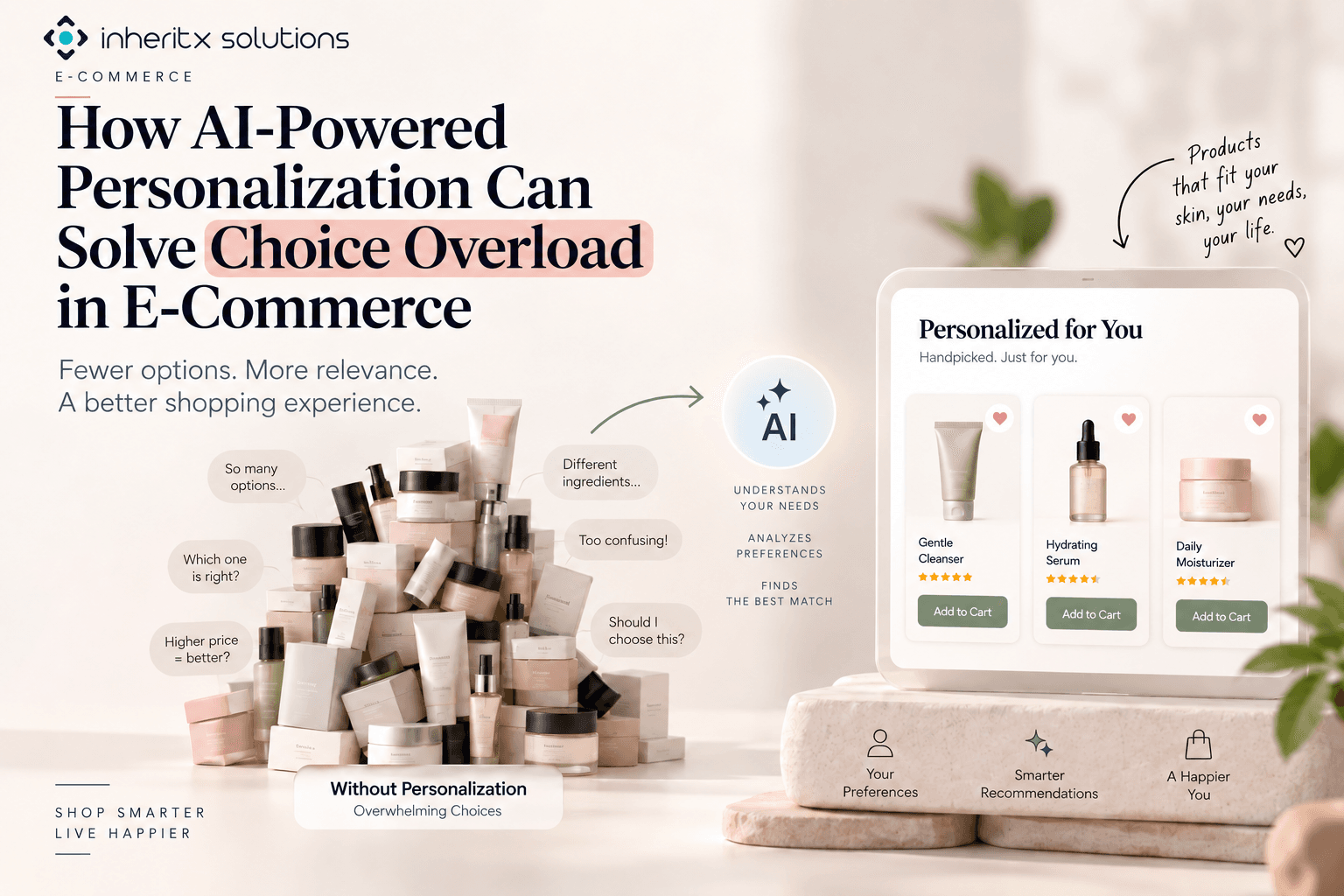
Imagine you’re shopping online for a simple daily moisturizer.
You start browsing and quickly find hundreds of options. Some promise deep hydration, others focus on skin-barrier repair, some contain hyaluronic acid, others highlight peptides or SPF. Then there are hundreds of reviews, different sizes, brands, and prices ranging from $12 to more than $150.
At first, having so many choices sounds great.
But after scrolling through page after page, it can start to feel exhausting. Which one is actually right for you? Should you choose the cheaper option? Is the expensive one really better? Does your skin even need all those ingredients?
Eventually, you close the tab and decide to come back later.
And sometimes, “later” means never.
This is one of the biggest challenges modern e-commerce businesses face. More products can attract more customers, but too many similar choices can make it harder for shoppers to make a decision.
This is where AI-powered personalization can make a real difference. Instead of asking customers to search through an enormous catalog on their own, personalization can help narrow the options down and bring the products that are most relevant to them to the front.
What Is Choice Overload in E-Commerce?
Choice overload happens when customers are presented with so many options that choosing one becomes difficult.
Having a large product catalog is usually seen as a benefit. But when shoppers have to compare dozens or even hundreds of similar products, the experience can quickly become frustrating.
Some common problems include:
- Too many similar products: Customers may see dozens of products that look almost identical but have small differences in features, ingredients, or specifications.
- Confusing product information: Technical terms, ingredients, specifications, and marketing claims can make it difficult to understand what actually matters.
- Time consuming comparisons: Customers may open several product pages or browser tabs just to compare prices, features, and reviews.
- Uncertainty about suitability: Even after finding a product they like, shoppers may still wonder whether it is actually right for their needs.
Of course, having a large selection does not automatically create choice overload.
It depends on the type of product, how familiar the customer is with the category, how complicated the decision is, and most importantly, how those choices are presented.
A well-organized catalog can feel helpful. The same catalog presented as an endless grid of similar products can feel overwhelming.
Why Traditional Product Discovery Can Fall Short
Traditional e-commerce tools such as search bars, category pages, filters, and bestseller lists are still important. They give customers a way to navigate large catalogs.
The problem is that they often put too much of the work on the shopper.
For example:
- Broad categories: A category such as “Skincare” or “Laptops” can still contain thousands of products.
- Generic bestseller lists: A product being popular with other customers does not necessarily mean it is the right choice for you.
- Rigid keyword search: Customers do not always know the exact product name or the right words to use when searching.
- Manual comparison: Opening multiple product pages and switching between them to compare features can quickly become tiring.
Traditional filters are not the problem. They are useful when customers already know what they want.
Personalization adds another layer. Instead of simply helping shoppers filter products, it can help understand what they are actually looking for and make the discovery process more relevant.
How AI-Powered Personalization Helps Shoppers Find Relevant Products

At its simplest, personalization means showing different customers different experiences based on what is relevant to them.
In e-commerce, this can happen in several ways:
- Behavioral recommendations: Suggesting products based on previous browsing, purchases, cart activity, or interactions.
- Contextual recommendations: Adjusting suggestions based on what the customer is doing during the current session.
- Content-based recommendations: Finding products with similar ingredients, features, styles, or attributes to products the customer has already shown interest in.
- Collaborative filtering: Using patterns from similar shoppers to identify products that may be relevant.
- Hybrid systems: Combining multiple recommendation approaches to improve relevance.
It is also worth pointing out that personalization does not always require a complicated generative AI system.
In many cases, simple rules, product attributes, recommendation algorithms, or collaborative filtering can already provide useful results. The technology should match the business problem rather than being added simply because it is called “AI”
Practical Ways AI Can Reduce Choice Overload
- Turning Large Catalogs into Relevant Shortlists
Imagine searching through 50 similar products and being shown the four or five that are most relevant to you instead.
That small change can make the shopping experience much easier.
Rather than asking customers to evaluate an entire catalog, personalization can narrow the starting point and help them focus on products that are more likely to meet their needs.
- Matching Products to Individual Preferences
Different customers can have very different requirements.
Someone shopping for skincare might have oily skin and prefer vegan products. Someone buying a laptop might care about screen size, battery life, or portability.
Personalization can use these preferences to remove irrelevant options and surface products that make more sense for the individual shopper.
- Improving Search and Product Discovery
Search does not have to mean showing everyone the exact same results.
For example, imagine a returning customer who regularly buys eco-friendly household products searches for “detergent.”
A personalized search experience could prioritize sustainable products based on that customer's previous interactions instead of making them apply several filters manually.
- Supporting Guided Shopping Experiences
Sometimes customers know what they need but do not know which product provides it.
A short quiz or guided product selector can help.
The customer answers a few questions about their preferences, requirements, or budget. The system then uses those answers to narrow down the available products.
Instead of browsing hundreds of products, the customer gets a more focused starting point.
- Helping Customers Compare Relevant Options
Comparison becomes much more useful when the number of products has already been narrowed down.
Comparing three products that actually fit a customer's needs is far easier than comparing thirty products that only loosely match the search.
How an AI-Powered Personalization System Works
Behind a simple recommendation on an e-commerce website is usually a combination of data, product information, algorithms, APIs, and user experience.
A typical personalization system can work through the following steps:
- Data Collection: The system collects relevant product and customer interaction data, such as clicks, views, cart additions, and purchases, while following applicable privacy requirements.
- Catalog & Attribute Structuring: Product information is organized into consistent categories, tags, and attributes so products can be compared and understood by the system.
- Candidate Generation: The system identifies a smaller group of products that could be relevant to the customer.
- Ranking & Contextual Filtering: Those products are ranked based on customer preferences, behavior, and the context of the current session.
- Display & Rendering: Recommendations are delivered through APIs and displayed naturally within the shopping experience.
- Evaluation & Iteration: Performance is monitored and the system is continuously refined based on what works and what does not.
For this to work well at scale, the underlying e-commerce infrastructure also matters. Recommendation systems need clean product data, reliable integrations, and fast APIs so personalization does not slow down the shopping experience.
Business Benefits of E-Commerce Personalization
When personalization is implemented thoughtfully, it can improve both the customer experience and the way shoppers interact with a store.
Some potential benefits include:
- More relevant product discovery: Customers spend less time looking through products that do not fit their needs.
- Less decision friction: A smaller, more relevant set of choices can make purchasing decisions easier.
- A more convenient shopping experience: Customers can reach useful products without navigating through endless categories.
- More relevant cross-selling: Complementary products can be suggested based on what a customer is already considering.
- Stronger customer relationships: A shopping experience that feels relevant and convenient can encourage customers to return.
These outcomes are not automatic. Results depend on factors such as catalog quality, customer data, traffic, personalization logic, and how well the experience is implemented. Personalization should be treated as an ongoing optimization process rather than a one-time solution.
Challenges Businesses Should Consider Before Implementing AI Personalization
Personalization can be valuable, but it also introduces practical challenges that businesses need to think about before implementation.
- Data Privacy and Consent
Customers need to understand how their data is being used. Businesses also need to follow applicable privacy and consent requirements when collecting and processing customer information.
- Recommendation Relevance
A recommendation only helps when it makes sense. For example, recommending a product someone purchased yesterday may create a poor experience rather than a personalized one.
- The Cold-Start Problem
New customers have little or no history for the system to learn from. The same problem can occur with newly launched products that have not yet received customer interactions.
- Catalog Data Quality
Personalization depends heavily on product information. Missing attributes, inconsistent tags, outdated descriptions, or poorly structured categories can make recommendations less accurate.
- System Integration
Recommendation systems often need to work alongside existing e-commerce platforms, inventory systems, ERPs, search tools, and other services. Poor integration can introduce delays and affect the overall customer experience.
- Preserving Discovery
Personalization should not become too restrictive. If customers are only shown products similar to what they previously purchased, they may never discover something new. Good personalization should still leave room for exploration and unexpected discoveries.
How to Measure the Impact of AI-Powered Personalization
Adding personalization is only the beginning. Businesses also need to understand whether it is actually helping customers.
Some useful metrics include:
- Recommendation Click-Through Rate (CTR): Shows how often customers interact with recommended products.
- Search and Discovery Engagement: Helps measure how effectively shoppers move from search or recommendations to product pages.
- Add-to-Cart Rate: Indicates whether recommended products are relevant enough to generate buying interest.
- Conversion Rate: Measures how many visitors ultimately complete a purchase.
- Product Return Rates: A change in returns can provide insight into whether customers are making better-informed purchases.
- Average Order Value (AOV): Helps businesses understand whether relevant recommendations and cross-selling are contributing to larger baskets.
It is important to establish a baseline before introducing personalization. Where possible, controlled A/B testing can help businesses understand whether changes in performance are actually coming from the recommendation experience rather than seasonality or other changes in traffic.
How InheritX Solutions Can Help Businesses Build Smarter E-Commerce Experiences
A large e-commerce catalog should give customers more possibilities, not more confusion.
Building that kind of experience requires more than simply adding a recommendation widget. The underlying platform needs to handle product data, integrations, APIs, customer interactions, and a fast user experience.
At InheritX Solutions, we work with D2C brands, retail businesses, and digital commerce companies to build scalable software solutions around their specific business requirements.
Our capabilities include:
- Custom E-Commerce Application Development: Building scalable and secure digital storefronts designed around business requirements and customer journeys.
- Personalized Product Discovery Integration: Integrating recommendation engines, guided shopping experiences, intelligent search, and product selectors.
- API and Catalog Integration: Connecting product catalogs, inventory systems, third-party services, and other business systems.
- Data-Informed Product Engineering: Building maintainable backend systems that support data collection, analytics, and future personalization capabilities.
Whether you are dealing with a growing product catalog, looking to improve product discovery, or planning a guided shopping experience, the right technology architecture can make the experience easier for both your customers and your business.
Ready to make product discovery easier for your customers? Contact InheritX Solutions to discuss your e-commerce platform and personalization requirements.
Conclusion: Make Every Product Choice More Meaningful
Good e-commerce personalization is not about showing customers more pop-ups, more banners, or more product carousels.
It is about making the choices they already have easier to navigate.
When a customer can quickly find products that match their needs, understand why those products are relevant, and compare a manageable number of options, the entire shopping experience becomes more straightforward.
That is where AI-powered personalization can play an important role.
For e-commerce businesses, the goal is not simply to build a larger catalog. It is to make that catalog easier to explore.
With the right product data, technology, and user experience, businesses can turn an overwhelming product catalog into a shopping journey that feels more relevant, useful, and human.
For companies looking to build or improve these experiences, InheritX Solutions can help design and engineer the underlying e-commerce infrastructure, integrations, and personalization capabilities needed to support them.
Frequently Asked Questions
1.What is AI powered personalization in e-commerce?
AI-powered personalization uses customer data, algorithms, and machine learning techniques to tailor product recommendations, search results, and parts of the shopping experience to individual customers.
2. How does AI help reduce choice overload in online shopping?
Instead of making customers sort through hundreds of products themselves, personalization can identify products that are more relevant to their preferences and present a smaller, more useful selection.
3. What is the difference between product recommendations and personalized search?
Product recommendations usually appear in dedicated areas of an e-commerce website and suggest products based on customer behavior or preferences. Personalized search works within the search experience itself, adjusting the results based on the individual customer and their context.
4. Does every e-commerce personalization system require machine learning?
No.Businesses can start with simpler approaches such as rules, product attributes, filtering, collaborative patterns, or other recommendation logic. More advanced machine learning can be introduced as the business and its data mature.
5. What data is needed for personalized product recommendations?
Depending on the system, useful data can include product attributes, customer interactions such as views and purchases, cart activity, and session information. This data should always be collected and processed according to applicable privacy requirements.
6. Can AI personalization improve e-commerce conversion rates?
Personalization can make product discovery more relevant and reduce the effort required to find suitable products. This may contribute to stronger engagement, add-to-cart activity, and conversions, but the actual impact depends on the quality of the implementation and the business context.
7. How can small e-commerce businesses get started with personalization?
Small businesses do not necessarily need to build a sophisticated AI system from day one.They can start by improving product metadata, using recommendation features already available through their e-commerce platform, and adding simple guided filters or product selectors to important category pages.