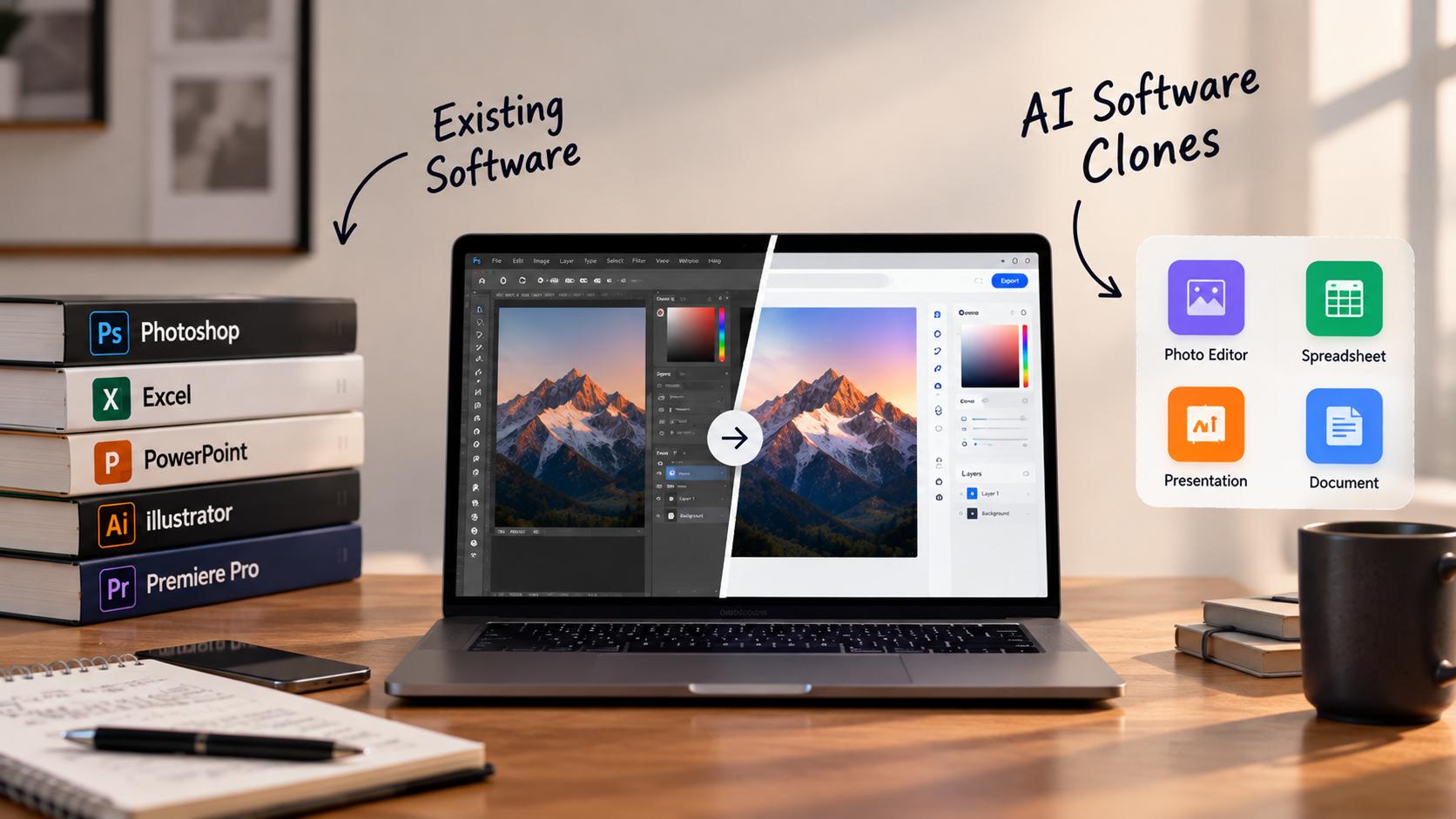
What if AI could help you build an alternative to software that took years to develop?
Imagine using a tool like Photoshop to edit images or Excel to manage business data. These applications have been developed and improved over many years. Building something similar once required a large team, considerable time, and significant investment.
But AI is beginning to change how software is built.
Today, AI coding tools can help developers write code, create user interfaces, fix errors, and turn ideas into working applications. This is opening the door for smaller teams to experiment with software products that were once difficult to build.
Two projects attracting attention in this space are REA (Reverse Engineer Anything) and ArtCraft. They highlight different parts of this change: understanding how existing software works and building alternatives to familiar applications.
But does this mean AI can replace established software products? Not so quickly. There is a big difference between creating an application that looks similar and building one that works reliably in real-world situations.
Let's understand what is happening and why it matters.
What Are AI Software Clones?
An AI software clone is an application designed to offer features or workflows similar to an existing software product. Developers can use AI coding tools to help build these alternatives without necessarily copying the original source code.
For example, imagine you want to build a simple alternative to Microsoft Excel. Your application might allow users to organise data, perform calculations, and create charts.
It would offer some of the same basic functions as Excel, but it would be a separate application with its own code.
AI can help developers build such features more quickly by generating code, suggesting solutions, and helping them fix problems.
However, creating a basic alternative is very different from reproducing every feature of a mature application. Established software often includes years of improvements, advanced functionality, and support for many different user needs.
This is where the idea of AI software clones becomes interesting. AI is making it easier to experiment with alternatives, but building a complete and reliable product remains a serious engineering challenge.
What Is ArtCraft?
ArtCraft is a project associated with efforts to create open source alternatives to familiar creative and productivity software using AI-assisted development.
Think about the applications people use every day. Designers work with image-editing and illustration tools. Office teams use spreadsheets, documents, and presentations.
Building alternatives to these products can be a major undertaking because users expect more than a good-looking interface. They also expect useful features, reliable performance, and compatibility with their existing work.
ArtCraft has attracted attention because it explores how AI-assisted development can help create alternatives in these established software categories.
Related projects have included tools such as GridCraft, DeckCraft, and WordCraft, inspired by spreadsheet, presentation, and document applications. The current status and capabilities of individual projects should be checked before publication.
Why is this interesting?
First, it demonstrates how developers can use AI to experiment with applications that would traditionally require substantial engineering work.
Second, it raises an important question: could smaller development teams build useful alternatives to products created by much larger companies?
Third, it encourages people to think differently about software development. Instead of treating every established product as impossible to challenge, developers can explore which features users actually need and whether they can build a useful alternative.
Still, an early-stage application is not automatically a replacement for a mature product. Advanced features, precise editing, file compatibility, and reliability can take significant work to get right.
ArtCraft should therefore be understood as an example of AI-assisted software experimentation, not proof that established creative applications can already be replaced completely.
REA vs. ArtCraft: What Is the Difference?
REA and ArtCraft are interesting for different reasons.
REA focuses on helping AI agents investigate existing software. ArtCraft demonstrates efforts to use AI-assisted development to build alternative applications.
In simple terms, one helps with understanding software, while the other shows what developers can attempt to create with AI assistance.
Together, they illustrate a broader change in software development: AI can help with more than writing individual lines of code. It can also support the process of understanding, planning, and building applications.
However, this comparison does not mean that REA and ArtCraft are integrated or that REA was used to build ArtCraft.
How Could AI Software Clones Change the Software Industry?
The rise of AI software clones could affect how businesses choose, build, and pay for software.
1. Startups could test ideas more easily
Imagine a startup that wants to build a tool for managing appointments at small clinics.
Instead of immediately investing in a large product, the team could use AI-assisted development to create an initial version and test it with potential customers.
This would help the team understand what users actually need before investing in a more complete product.
2. Businesses could build tools around their needs
Many businesses pay for software that includes dozens of features but use only a few of them.
AI-assisted development could help them explore simpler tools designed around their daily workflows.
For example, a company might need a basic inventory system that tracks stock, manages orders, and generates reports. A customised application could focus on these specific requirements.
The business would still need to compare development and maintenance costs with the cost of existing software. Building a custom application is not always the cheaper option.
3. Established software companies could face more competition
When customers have more alternatives, software companies may need to work harder to demonstrate their value.
That value might come from better performance, advanced features, strong customer support, useful integrations, or trusted security practices.
A basic alternative may be enough for some users, while others will continue to prefer established products because of their reliability and extensive capabilities.
4. Developers could focus more on solving business problems
AI can help with certain coding tasks, but businesses still need people who understand their customers, plan the system architecture, review code, and make important technical decisions.
The developer's role is not simply to generate code. It is to ensure that the software solves the right problem and works as expected.
The Challenges Behind AI Software Clones
AI can help developers create impressive demonstrations, but a working demonstration is not the same as production-ready software.
Consider a spreadsheet application. It might look similar to a familiar tool and handle basic calculations correctly. But what happens when a user imports a large file, uses complex formulas, or shares the document with someone using another application?
This is where hidden challenges become important.
- Security: AI-generated code can contain vulnerabilities. Developers must review and test it before using it for sensitive business operations.
- Reliability: A feature that works in one example may fail when users provide unusual inputs or follow unexpected workflows.
- Compatibility: Supporting existing file formats, integrations, and complex documents can be difficult.
- Maintenance: Software needs regular updates, bug fixes, and improvements after launch.
- Legal considerations: Developers must respect applicable software licences and intellectual-property rights. Building similar functionality is not automatically illegal, but the methods and materials used matter.
- Long-term costs: Even if AI helps reduce initial development time, hosting, testing, security, and maintenance still cost money.
These challenges explain why AI-assisted development needs human expertise. AI can speed up parts of the work, but it cannot remove the responsibility to deliver dependable software.
What Should Businesses Consider Before Using AI-Built Software?
Before adopting an AI-built application or investing in a custom alternative, businesses should ask a few important questions.
- Does the application solve a real business problem?
- Does it support all the features the business actually needs?
- Has its security been reviewed?
- Can it handle real workloads and unexpected situations?
- Does it work with existing tools and data?
- Who will maintain it and fix problems after launch?
- Have licensing and intellectual-property concerns been considered?
- Is it genuinely more cost-effective than buying an existing product?
A promising demo can be a good starting point, but businesses should make decisions based on real testing, long-term costs, and the needs of their users.
What This Means for InheritX Solutions
For businesses looking to build or improve digital products, the growth of AI-assisted development creates new opportunities.
At InheritX Solutions, this trend connects with an important goal: helping businesses turn technology ideas into practical software solutions.
AI-assisted development can support several types of projects.
- Custom software development: Businesses can explore applications built around their specific processes rather than trying to fit every requirement into a general-purpose product.
- Legacy software modernisation: Existing systems can be analysed and improved, helping businesses address technical limitations and prepare for future needs.
- AI integration and automation: AI capabilities can be introduced into business workflows where they provide genuine value.
- Prototyping and product development: Teams can test ideas, gather feedback, and improve their products before committing to a larger implementation.
The key is to combine AI's speed with proper engineering practices. Architecture, testing, security, scalability, and maintenance must remain part of the development process.
For businesses, the goal should not simply be to build software faster. It should be to build software that solves real problems and continues to deliver value over time.
Conclusion: Faster Coding Is Only the Beginning
The rise of AI software clones is changing how people think about building software.
REA highlights how AI agents can be assisted in investigating existing applications. ArtCraft demonstrates how developers are using AI-assisted approaches to explore alternatives to familiar software.
Together, they show that creating software prototypes and experimenting with new products may become more accessible.
But building a reliable application still requires much more than generating code. Businesses need secure systems, useful features, dependable performance, and ongoing support.
AI may make it easier to start building. The real challenge is building something people can trust.
At InheritX Solutions, we believe that successful digital products come from combining new technology with thoughtful engineering and a clear understanding of business needs.
Looking to build a custom application, modernise an existing system, or explore AI-powered development? Connect with InheritX Solutions to discuss your next digital product.
Frequently Asked Questions (FAQ)
1. What are AI software clones?
AI software clones are applications designed to provide features or workflows similar to existing software, with AI coding tools helping developers build the alternative.
2. What is REA?
REA, or Reverse Engineer Anything, is an open-source tool that connects AI coding agents with software-analysis tools to help investigate how existing applications work.
3. What is ArtCraft?
ArtCraft is associated with AI-assisted efforts to create open-source alternatives to established creative and productivity applications.
4. Can AI completely replace existing software?
Not necessarily. AI can help developers build useful alternatives, but matching a mature product's advanced features, reliability, compatibility, and performance can require substantial engineering work.
5. Are AI software clones legal?
It depends on the specific implementation, the materials used, the applicable licences, and relevant intellectual-property laws. Developers should review these issues before releasing a product.
6. Is AI built software ready for business use?
It can be, provided it passes appropriate security reviews, testing, performance checks, and ongoing maintenance planning. AI-generated code should not be treated as production ready without proper validation.