Imagine years of telescope observations sitting in public archives. Satellites have recorded faint changes in distant starlight second by second, storing terabytes of photometric measurements. Somewhere inside those massive datasets lies a subtle pattern, a periodic dip in brightness that no human eye or classical pipeline has closely investigated.
What happens when an independent developer utilizing AI coding agents like Claude Code and OpenAI Codex investigates that NASA archive and flags a possible planet candidate? Does this signal the beginning of the end for astronomers or the opening chapter of a new era in human-AI scientific collaboration?
The central question facing scientific institutions globally from research centers in India, including tech hubs in Ahmedabad and Gujarat, to universities across Australia, the United States, and Europe is clear: Will AI take astronomers jobs, or will it fundamentally transform how humans discover and comprehend the cosmos? To answer this, we must look beyond exaggerated headlines and examine what AI coding agents actually do, what recent exoplanet investigations demonstrate, and where human expertise remains irreplaceable.
A Possible Planet Hidden in NASA Data and the AI Tools That Helped Investigate It
The intersection of generative AI and astrophysics captured global attention recently when software developer Pavel Rabtsevich shared his investigation of public space telescope data. Rabtsevich set out to explore raw data collected by NASA’s Transiting Exoplanet Survey Satellite (TESS).
TESS spends months monitoring thousands of stars across dedicated sectors of the sky, gathering continuous brightness readings. When an exoplanet passes between its host star and the observer, it blocks a tiny fraction of the star's light, an event known as a transit. Because TESS generates vast volumes of data, millions of faint or complex signals remain unanalyzed in public repositories.
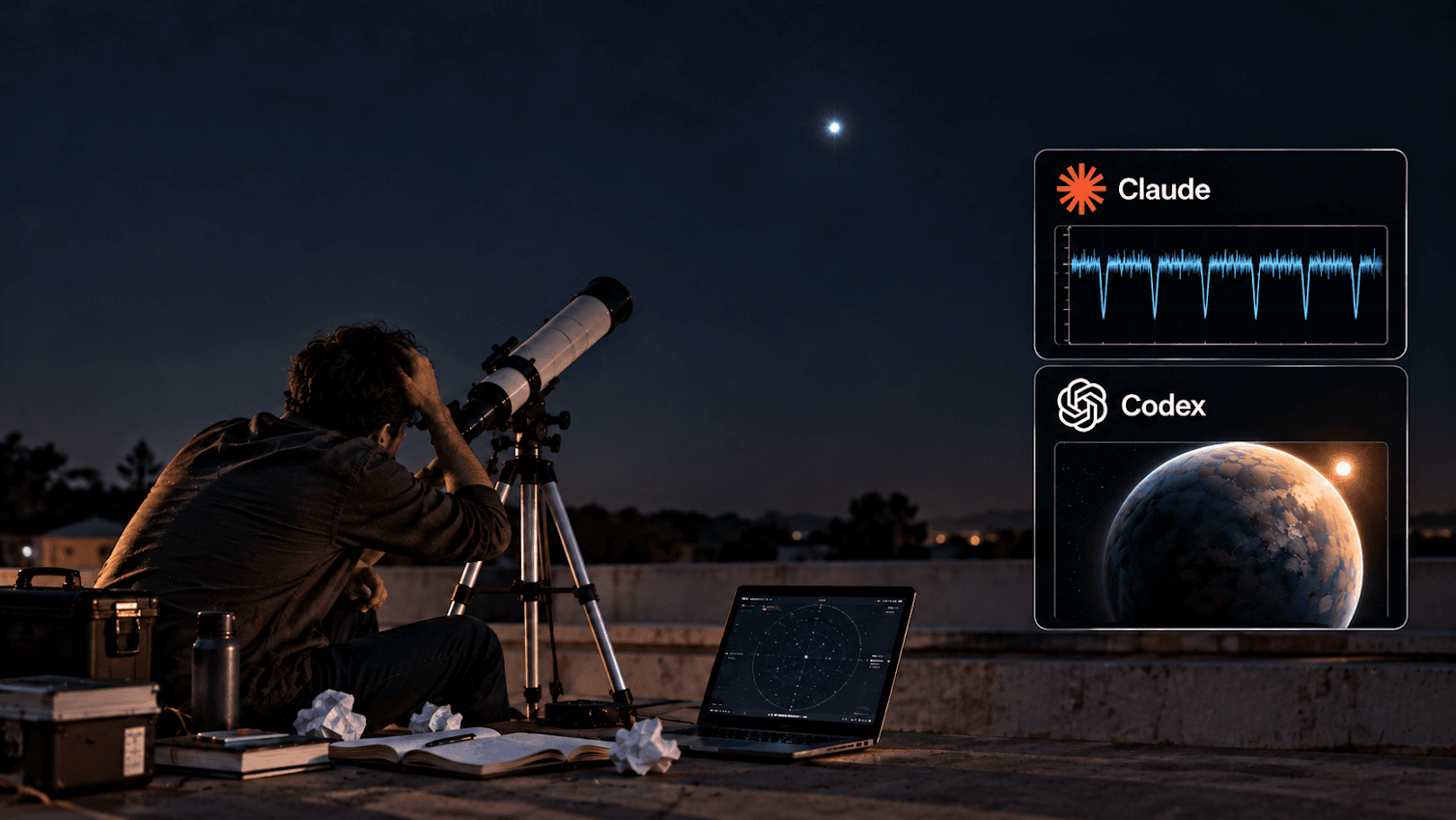
While reviewing photometric measurements around star TIC 4206066, Rabtsevich noticed a faint recurring anomaly. Over two weeks, he conducted approximately 74 analytical passes and generated over 1,000 helper scripts using Anthropic's Claude Code and OpenAI's Codex. The reported candidate signal exhibits specific properties:
- Periodic Dimming: The host star dims by approximately 0.05% for roughly two hours.
- Regular Interval: The signal repeats every 3.18 days across multi-year TESS sectors.
- Estimated Physical Size: If proven to be a transiting exoplanet, the candidate would measure roughly 1.4 Earth radii.
- Target System Distance: The star system is located approximately 116 light-years from Earth.
The story gained traction across technology and science communities not because an AI autonomously discovered a verified world, but because a single developer used conversational AI coding agents to process complex raw datasets, write validation code, and formulate a proposal that led to scheduled follow-up observations.

How Can AI Help Find a Planet?
Understanding how AI coding agents contribute to scientific discovery requires separating physical observation from data processing.
How the Transit Method Works
The transit method relies on geometry and photometry. When a planet's orbit aligns with our line of sight, it periodically transits its star, causing a characteristic dip in the light curve. However, a dimming event is not immediate proof of a planet. Instrumental glitches, starspots, background eclipsing binary stars, and light blending can all mimic a planetary transit.
What AI Coding Agents Actually Do
Tools like Claude Code and OpenAI Codex do not possess physical intuition or observational capabilities. Instead, they act as active software engine partners. In Rabtsevich's workflow, the AI coding agents assisted by:
- Writing custom Python scripts using libraries such as Lightkurve and AstroPy to download and parse TESS datasets.
- Cleaning raw light curves by removing noise, momentum dumps, and satellite scattered light.
- Executing Box-Least-Squares (BLS) periodograms to search for faint, repeating transit signatures.
- Automating diagnostic routines to check whether the dimming coincided with telescope jitter or neighboring stars.
From a Suspicious Signal to a Scientific Candidate
An AI agent can rapidly write a script to plot a light curve, but transforming a suspicious dip into a recognized candidate requires rigorous statistical vetting. Researchers run false-positive probability tools like TRICERATOPS to evaluate whether background stars or binary systems could produce the observed signal. The agent speeds up code execution, but the human researcher must structure the tests and verify that the mathematical assumptions are physically valid.
Why the Possible Exoplanet Is Not Yet a Confirmed Discovery
A critical distinction in scientific reporting is the difference between a planet candidate and a confirmed exoplanet.
Rabtsevich’s object remains an unconfirmed candidate. In exoplanet science, a recurring light dip is merely a hypothesis. To move from a candidate signal to an official confirmation, several strict scientific conditions must be satisfied:
- Independent Ground-Based Photometry: Ground-based telescopes must observe the transit at higher spatial resolution to ensure the dimming originates from the target star rather than a nearby background star.
- Radial Velocity Measurements: Spectrographs must measure the slight gravitational wobble of the host star to estimate the orbiting object's physical mass, proving it is a planet rather than a low-mass star or brown dwarf.
- Peer-Reviewed Validation: The methodology, data processing pipeline, and statistical tests must undergo formal peer review by independent astrophysicists.
While Director’s Discretionary Time (DDT) observations or follow-up campaigns may be scheduled, an observing proposal is an opportunity to gather more evidence, not a validation of discovery. Until independent observations verify the mass, radius, and origin of the signal, the candidate remains an unverified hypothesis.
AI in Astronomy Is Not New
While recent headlines emphasize conversational AI coding agents, artificial intelligence has been integral to astrophysics for years.

Back in 2017, NASA announced the discovery of Kepler-90i, an eighth planet in a distant star system found using a convolutional neural network trained on Kepler telescope data. That machine learning model identified faint signals that human reviewers and standard algorithms had overlooked.
Similarly, NASA’s ExoMiner and ExoMiner++ frameworks utilize deep learning running on supercomputers to analyze light curves, evaluate transit features, and distinguish true exoplanet signals from false positives across thousands of targets.
The shift occurring today is not the arrival of AI in astronomy, but rather the democratization of AI tools. Previously, running machine learning pipelines required specialized computational infrastructure and custom code. Today, general-purpose AI coding agents allow researchers and independent developers to build, modify, and execute data pipelines using natural language.
Will AI Replace Astronomers or Change Their Jobs?
To answer whether AI will take astronomers' jobs, we must evaluate how automation impacts specific daily tasks versus core scientific responsibilities.
Research Tasks Handled Efficiently by AI
AI coding agents and machine learning pipelines excel at repetitive, highly structured computational workflows:
- Data Ingestion and Ingest Pipelines: Querying databases, converting file formats, and normalizing light curves.
- Pattern Recognition: Scanning millions of light curves to flag statistical anomalies.
- Boilerplate Code Generation: Writing scripts for plotting, Fourier transforms, or standard fitting functions.
- Initial Literature Cross-Referencing: Searching archives to check whether a target star has known binary companions.
Why Human Expertise Remains Essential
Despite these capabilities, AI agents cannot substitute for the foundational elements of the scientific method:
- Formulating Scientific Questions: AI can analyze data given a prompt, but it cannot decide which physical questions are most significant to astrophysics.
- Understanding Instrument Physics: Evaluating whether a 0.05% dimming is caused by a planet or an optical artifact requires an understanding of hardware mechanics, detector physics, and atmospheric conditions.
- Physical Interpretation and Synthesis: An AI agent can fit a curve to data points, but connecting that curve to atmospheric physics, orbital dynamics, and planetary formation theory requires human scientific judgment.
- Accountability and Truth: AI models can produce plausible code that contains subtle logical errors. The ultimate responsibility for verifying scientific claims lies with human researchers.
Rather than eliminating astronomers, AI is shifting their role from manual data processing toward higher-level analysis, experimental design, and physical interpretation.
What This Means for the Future of Scientific Research
The integration of AI coding agents into research brings both structural advantages and notable challenges.
Opportunities
- Lowering Entry Barriers: Independent researchers and students can analyze complex datasets without years of specialized software engineering experience.
- Accelerated Testing: Hypotheses that once took months of manual scripting can now be coded, executed, and tested in days.
- Unlocking Archived Data: Millions of older observational files sitting in public storage can be re-examined efficiently.
Risks and Challenges
- Plausible but Incorrect Analysis: AI agents can generate code that executes cleanly while applying incorrect physical assumptions or statistical transformations.
Zeniteq - Data Provenance and Reproducibility: As workflows involve hundreds of AI-generated iterations, documenting the exact code, parameters, and random seeds becomes vital for peer review.
- Noise vs. Signal Bottlenecks: Lowering the barrier to submitting candidate proposals can overwhelm peer-review systems and observational facilities with unverified claims.
The Skills Astronomers May Need in an AI-Assisted Future
As AI coding agents become standard research assistants, the required skill set for astronomers is evolving. Proficiency in Python, observational statistics, domain physics, and AI steering is replacing manual boilerplate programming.
| Research Activity | How AI Can Help | Why Human Oversight Matters |
| Data Processing | Automates repetitive workflows and data cleaning. | Ensures correct physical assumptions and calibration standards. |
| Pattern Detection | Flags unusual signals across millions of light curves. | Determines whether detected patterns are physically meaningful. |
| Hypothesis Testing | Quickly generates and executes diagnostic code scripts. | Evaluates physical plausibility and checks for systemic biases. |
| Validation | Automates statistical routines (e.g., false-positive tests). | Assesses total observational evidence and physical uncertainties. |
| Scientific Interpretation | Summarizes output datasets and plots visual models. | Connects empirical findings to broader astrophysical theory. |
What Businesses Can Learn from AI-Assisted Scientific Discovery
The dynamics transforming exoplanet research parallel the shifts occurring across enterprise technology and software development.
Just as an AI coding agent assists an independent researcher in querying NASA archives, enterprise AI agents can help businesses automate multi-step data processing, streamline engineering tasks, and uncover insights within internal databases. However, the core lessons remain identical across both domains:
- Automation Requires Validation: Generating code or processing records rapidly is valuable only if the underlying logic is audited and verified.
- Human Expertise Is the Control Layer: AI tools accelerate execution, but domain experts are necessary to establish context, evaluate risk, and make final decisions.
- Structured Workflows Beat Raw Output: Success depends on building repeatable pipelines with clear inputs, error checking, and measurable outputs.
As a technology partner specializing in custom AI solutions, cloud architecture, and intelligent automation, InheritX Solutions helps organizations integrate modern AI workflows into their enterprise software stack ensuring that automated tools enhance human decision-making rather than replacing critical oversight.
So, Will AI Take Astronomers Jobs?
When we examine the facts behind Pavel Rabtsevich’s investigation, the takeaway is not that an AI system independently discovered a planet. The true story lies in how general-purpose AI coding agents allow motivated individuals to process complex, public scientific archives with greater speed and efficiency.
AI is not taking astronomers jobs. Instead, it is stripping away the tedious computational overhead that previously slowed down scientific inquiry.
AI may change who can investigate the universe and how quickly they can test an idea. But discovering a pattern in data is only the beginning; establishing what that pattern means physically remains the true scientific challenge.
Frequently Asked Questions
1. Will AI replace astronomers in the future?
No. AI is unlikely to replace professional astronomers. While AI models and coding agents excel at processing massive datasets, writing analytical scripts, and flagging unusual signals, human expertise remains essential for formulating research hypotheses, understanding observational physics, evaluating uncertainties, and validating conclusions.
2. How did Pavel Rabtsevich use Claude Code and Codex to investigate a possible planet?
Pavel Rabtsevich used Claude Code and OpenAI Codex as conversational coding assistants. The agents helped him write and refine Python scripts to download, clean, and process NASA TESS data, run Box-Least-Squares periodic signal searches, and execute diagnostic checks to rule out common instrumental noise.
3. Has NASA confirmed the possible exoplanet found in its TESS data?
No, the candidate is not a confirmed exoplanet. While follow-up observations may be scheduled, the signal remains an unverified planet candidate. Confirmation requires independent ground-based photometry, radial velocity mass measurements, and peer-reviewed scientific validation.
4. How does AI help scientists discover exoplanets?
AI assists exoplanet discovery primarily through pattern recognition and workflow automation. Machine learning models like ExoMiner analyze light curves to distinguish true transit signals from false positives, while AI coding agents help researchers write analytical pipelines and process large data archives faster.
5. What is Claude Code, and how is it different from a scientific AI model?
Claude Code is an agentic command-line tool designed to write, edit, test, and execute software code via natural language prompts. Unlike dedicated astrophysics AI models trained on light curves (such as ExoMiner), Claude Code is a general-purpose programming assistant that helps developers build and manage software pipelines.
6. Can someone without an astronomy degree use AI to analyse NASA data?
Yes. NASA’s space telescope datasets are publicly accessible. AI coding agents allow individuals without advanced computer science or astrophysics backgrounds to write functional data analysis scripts. However, correctly interpreting the results still requires a clear understanding of observational astronomy and statistical validation.
7. What skills will astronomers need as AI becomes more common in research?
Astronomers will increasingly need skills in AI prompt engineering, statistical validation, data provenance, and automated pipeline architecture, alongside core strengths in Python, physics, and scientific methodology. The focus will shift from manual coding to auditing AI outputs and physical interpretation.